Mary E
Mariners' Museum, Uncurated Search Results
Type: Skipjack
Year: 1901
Builder:
Location: Hopkins

These records are found in the online catalog of The Mariners’ Museum and Park in Newport News, Virginia. Uncurated search results are presented to give researchers and interested readers an idea of whether the museum’s archives contain information about this vessel and whether it may be worthwhile to visit the museum’s catalog search page for further investigation. Uncurated results may be inaccurate or incomplete.
Search mode: Type+Name and Schooner+Name. Search phrase(s): "Skipjack Mary E"; "Schooner Mary E". Results returned: 2. Results displayed in this table: 2.
Use these buttons to send uncurated search results to your own app or text document for further research. First, check the box for any row, or click "Select All" then uncheck any rows. Then click "Show Selections". You can then copy your selections from the text box and past them into your app.
| Fetch? | Row ID | Media | Date | Vessel | Place | Related Places | Inscription/Marks | Subject | Notes | Archive Number |
|---|---|---|---|---|---|---|---|---|---|---|
| 1 | 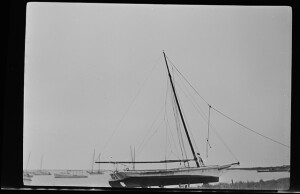 | 5/25/1941 | Mary E. (Sloop : 1901). | Deal Island (Md.). | Envelope: "Skipjack Mary E. [illegible] down. Wenona, MD. 5-25-41" | Skipjacks–Maryland–Deal Island.; Sloops–Maryland–Deal Island.; Harbors–Maryland–Deal Island. | Shows a starboard side view of a sloop out of the water on blocks. Some other boats can be seen in the water in the background. There is no caption for this negative. | MS0063/01-755#0755 | ||
| 2 | 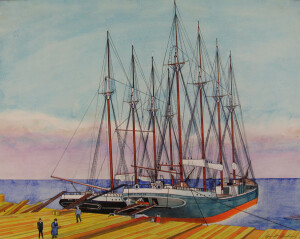 | NOTES: Notes by Emmett Hoskins accompanying the drawing: "I made this drawing to show how long lengths of timber, poles, piling, etc. were loaded aboard sailing vessels when the length of the timber was to(o) long to be lowered in the hold through the hatch. All West Coast vessels in the lumber trade had bow cargo ports for loading and discharging long lengths of timber, piles, etc. and many had counter cargo ports as well, like shown in the drawing. The schooner, MARY E. FOSTER is hauling a long piece of timber into the hold through her port cargo port. They are using a drag runner to make the work easier. You will note the skids between the dock and cargo ports; they have hard-wood rollers to make it easier to haul the timber in the hold. By the port skids can be seen a small two wheeled dolly which was placed under the timber while it was being hauled to the cargo port skids. The schooner ERIC has completed loading her hold through her cargo ports, and has the cargo ports secured in place, and they are loading her deck load. She has dolly loads of lumber on the dock waiting to be hauled over her poop to the main deck for storing. She also has her "Honolulu Purchase Cargo Gear’ rigged and she could also take lumber from a barge along side to complete her deck load of lumber. During the 1920’s, the schooner ERIC well, my friend Jack Delaney of Newfoundland shipped in her at San Francisco and she sailed for the Pacific Northwest (a British Columbia port I think) to load lumber for Australia. After sailing from a Pacific Northwest port for Australia, she put into Honolulu, water logged with only her poop and forecastle-head above water and all the officers and crew living on the deck load. It seems she had a very hard passage. She was many months in Honolulu, where all her lumber cargo had to be discharged and it was necessary to repair her and replank her in some places about the counter. The last I saw the ERIC was at Seattle dock in 1925. And at that time, she appeared in good seaworthy condition. So it seems the repair work and caulking done at Honolulu a year or so before had been a good job. I do not know when the ERIC was built but in 1925, when I last saw her, she seemed to be quite an old schooner, but in good condition." | CL5207 |
Created 2026 by Don Barker, CBMM volunteer, for the Chesapeake Shipbuilding Project. shipbuilding@sailingworkboats.es